TECHFUND
Media


Ethereum’s Initiative for mass adoption
The web 2.0 innovations spoiled us with the ease of use, extremely user friendly and stunningly looking user interfaces. The mobile application revolution was able to successfully onboard a major chunk of earth’s population. User experience is the key ingredient for such mass adoption.
Frankly, any one interacting with blockchain finds their first interaction overwhelming, irrespective of their exposure to technical knowledge. The wallet installation, the seed words and signing a transaction does not seem like an intuitive flow, especially after web 2.0 generation applications.
There is no doubt, Blockchain is a bleeding edge technology with broad use cases, almost every transaction today has a place in blockchain that will redefine in how we interact with layer of innovation. But, for that to effectively happen, mass adoption is critical.
Ethereum has two different types of accounts, namely, EOA and smart contracts. EOA(Externally owned accounts) are the one’s that can initiate a transaction by signing with a private key. Any individual or entity interacting with blockchain will have an EOA to operate with.
Keeping regulatory aspects aside, there are certain technological barriers that are standing in the way of mass adoption.
a) Managing private key
b) Gas for transaction in native currency
c) Bundling transactions
Managing private key:
We all found comfort in the ability to restore our password if forgotten during our engagement with Web 2.0 mobile/web applications. But, in the case of blockchain, private key is the premises for account address, public key etc. So, there is no option out there to change the private key if lost. Users find this responsibility very overwhelming and are taken aback.
Gas for transaction in native currency:
Any interaction by EOA with blockchain will initiate a transaction that needs enough native tokens to be available in the account for transaction to be accepted. Getting this balance into the account is a very round about process involving conversion of fiat currency into cryptocurrency. The obligations like kyc that come along as equally overwhelming.
Bundling transactions:
Every transaction involves cost, but bundling transaction together can be most cost effective.
EIP-4337
To address this concerns and onboard 1 billion users onto Ethereum blockchain, many proposals were submitted, of which EIP-4337 was accepted and is currently undergoing adoption by various protocols.
The EIP-4337 proposal was an innovative approach as it does not require any changes in consensus layer or the current architecture of Ethereum. Instead, it adds additional layer between the user and the current Ethereum architecture to facilitate a better user experience.
Key aspects of the proposal
a) Smart contract Wallet
Smart contract Wallets are typically implemented using a smart contract that manages the funds and provides functionality such as sending and receiving transactions, managing private keys, and executing other functions based on certain conditions. Standard EOA models have limitations, including the potential for users to lose or forget their seed phrase, high gas fees for interacting with smart contracts, and limitations on wallet customisation.
Account abstraction addresses these limitations. Smart contract wallets will operate on EOA, but will offer a layer of customisation for managing the private key via social recovery.
b) User Operation
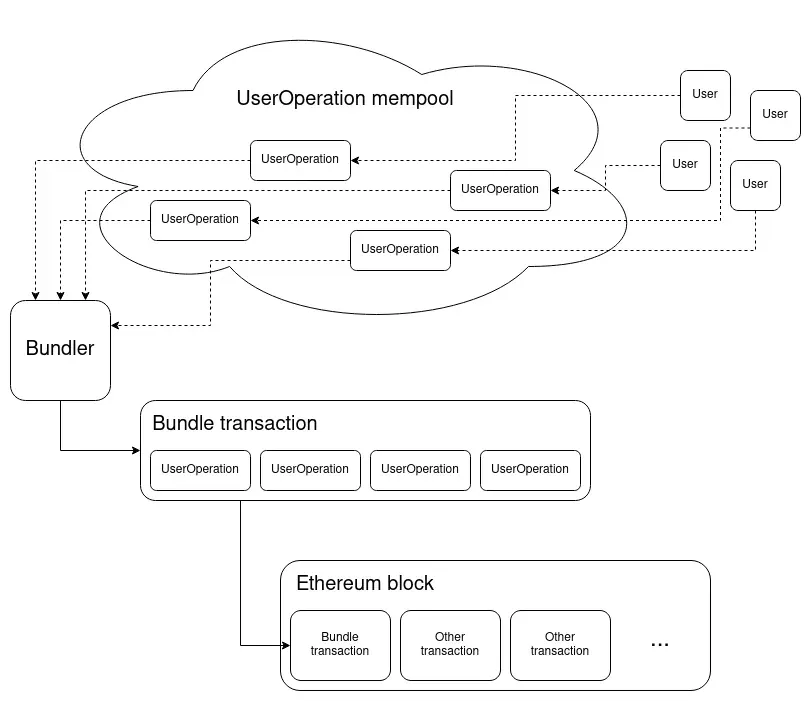
EIP 4337 proposes a new object called user operation. User operations are created, signed by users via the Smart Contract Wallet. The user operations are similar to transactions but they are routed through User operations Pool. Users will create a User Operation pseudo-transaction object and sign it.
struct UserOperation {
    address sender,
    uint256 nonce,
    bytes initCode,
    bytes callData,
    uint256 callGasLimit,
    uint256 verificationGasLimit,
    uint256 preVerificationGas,
    uint256 maxFeePerGas,
    uint256 maxPriorityFeePerGas,
    bytes paymasterAndData,
    bytes signature
    }
c) User Operations Pool
User operations are submitted into User operations MemPool, which is different from the Mempool in the current Ethereum architecture.
d) Blunder
A bundler process watches the user operations Pool, bundles the user operations together into single entity called a bundle and submits to entry point contract.
e) Entry point contract
EntryPoint is a smart contract receiving the operations from the blunders. And it’s responsible for unpacking, verifying, and executing User Operations.
f) Paymaster
ERC-4337 introduces paymaster mechanism responsible for handling the implementation of gas payment policies. The policy offers the option on who will pay for the gas. It could be the user initiating the transaction or it could be the protocol that would like to onboard users and hence pays on their behalf.
The protocol recovers the fee paid from generated revenue through interactions by on-boarded users.
Also, paymaster has provisioned the flexibility to accept gas in native or other erc20 tokens.