TECHFUND
Media


The Role of EIP-4844 and Blobs in Scaling Ethereum
Why EIP-4844 often called “Proto-Danksharding”
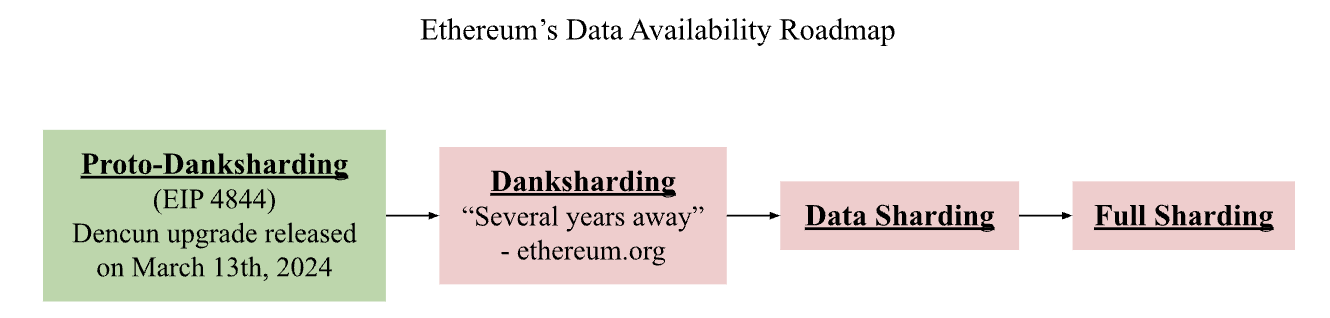
The reason why EIP-4844 called, “proto-dankSharding”, because it is a proto type and first step towards large envisioned idea of Sharding, which ultimately breaks the blockchain trilemma. Sharding is a method of distributing data across multiple machines, enabling more efficiency as it can process more data at a faster rate, with over 100,000 transaction per second.
Blockchain Trilemma is the challenge of simultaneously achieving Decentralization, Security, and Scalability in a blockchain network.
The Problems L2 Rollups Faced Before EIP-4844
The core function of a Layer 2 (L2) rollup is to perform transactions off-chain, roll them up, and then post them as a compression batch on the Ethereum mainnet (Layer 1). This allows the L1 to inherit the security of Ethereum without having to process every single transaction.
But the key issue here is that how they posted data on L1. Before EIP-4844 introduced, rollups have only one way to store the data on-chain, i.e., via CALLDATA field of standard Ethereum transaction.
CALLDATA is expensive, because data that entered through this field stored on-chain forever. This permanent storage is overkill for rollups because they only need the data for some amount of time, which is being used by challenger to verify the batch transaction. So, these high cost were inevitably passed down to the end-users of the L2, making transactions cheaper than on L1, but still too expensive for mass adoption.
The cost of CALLDATA was tied to the general gas fee market of Ethereum. So if there were any spike of gas prices, due to surge in demand on L1, the operational cost for L2 become volatile and unpredictable, which increases the gas needed for batch transactions.
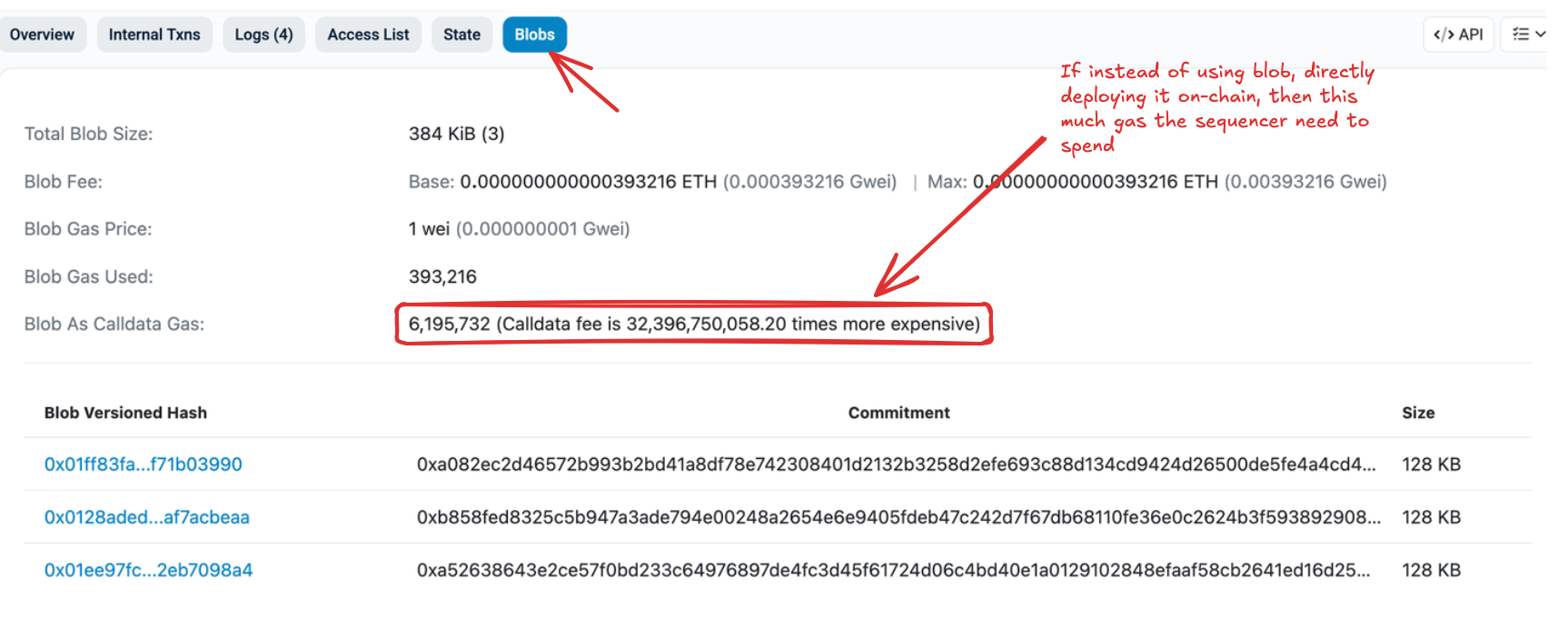
This is where EIP-4844 comes into picture with so called data layer, named blob, to reduce nearly 10-100 times cheaper than CALLDATA. We can see how cheap using blob compare to CALLDATA to batch transactions.
Why Blobs are so Cheap?
You may have a doubt, why do blobs are so cheap, when they are also being posted on-chain. There are mainly 2 reasons:
The reason why
CALLDATAis expensive isn’t because it was posted on-chain, rather it was being stored and made accessible to every node on the Ethereum network. UnlikeCALLDATA, data within blob is not accessible to the Ethereum Virtual Machine (EVM) execution, but the commitment can be accessed. Since the EVM doesn't have to process the data, the computational cost is far lower.Another reason was that blobs will not store on-chain forever, rather only available for short period, currently it was 18 days. This is more than enough time for any "challenger" to verify the rollup's state and ensure no fraud occurred. Once the period completes, the data get deleted by the nodes. This temporary rental of data space is way more cheaper than the permanent storage offered by
CALLDATA.
EIP-4844 — Type-3 Transaction
When Ethereum consensus mechanism switched to Proof of Stake from Proof of Work, running a full ethereum node requires both a consensus client, i.e., beacon node, and an execution client, i.e., EVM. The two clients communicate with each other via local API to create a unified view of network.
Beacon node handles consensus and block finalization
Execution client processes transactions within those blocks
Similar to Type-0,1,2 transactions, Type-3 transactions can also be in the mempool, but the actual content of the blob will one be go through consensus client, i.e., Beacon node, and not available on the execution client. So, type-3 transaction only contains a reference to the blob, also known as versioned hash, and not the blob itself.
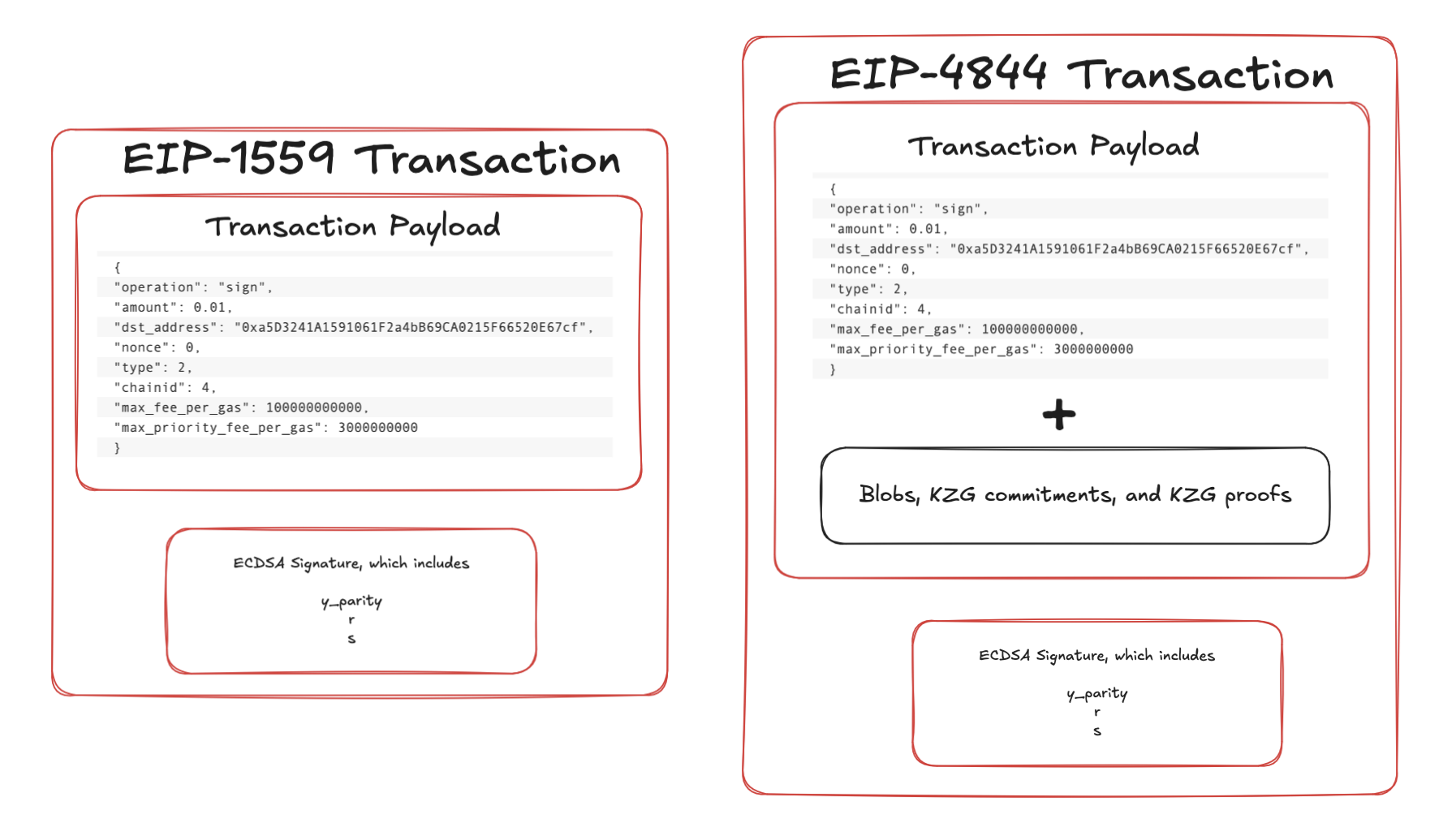
Some details about Type-3 transactions:
Each block can have up to 6 total blobs
Each type-3 transaction can also have up to 6 blobs, which means if within a transaction all 6 blobs were used next sequencer need to wait for the whole block to run the blob transaction.
Each blob stores up to 128kb of data, which essentially have 4096 field elements with each can hold up to 32 bytes of data. Irrespective of the data length of the blob, the user need to pay for the entire blob once used.
Blobs are only required to be stored for 4096 epochs(~ 18 days). This time period is large enough for the challengers to retrieve to verify. This allows blobs to be priced cheaper than calldata, which is stored forever.
How Rollups Prove their State?
You may get question, like how exactly does rollups prove their state if they cannot access the blob data, as it was not stored on EVM. This is why EIP-4844 introduces new type of cryptography called KZG (a fixed-size vector commitment scheme), which is being used to commit and verify blob data.
KZG Polynomial Commitment — KZG (Kate-Zaverucha-Goldberg) is a cryptographic scheme that takes the blob data, represents it as a polynomial, and generates a short, fixed-size commitment.
This small commitment (48 bytes) is what the EVM and smart contracts interact with, instead of the massive 128 KB blob itself.
KZG Proof — Demonstrate that the data within the blob corresponds to the commitment, without needing to process the whole blob
L2 rollups can submit proofs to L1 smart contracts. The smart contract can then use a new tool called a "point evaluation precompile" to verify this proof. This precompile checks that the blob data is valid and was made available to the network, which is critical for the security of rollups. It allows anyone to challenge or verify the data without congesting the main network.
Blob Data Verification — Point Evaluation Precompile
Though the data within the blob not stored in the EVM, but the commitment hash was stored. So, how can we verify the specific data exists within the blob or not? for efficient verification of specific data within a blob, EIP-4844 introduced “Point Evaluation Precompile” in the EVM. Let’s see how exactly this so called point evolution precompile works:
Let’s say we want to verify a specific field element within a blob, as it holds 4096 field elements.
Perform KZP commitment for the specific data. E.g.,
p(z) = ygiven commitment that corresponds to the polynomialp(x)and a KZG proofNow Let’s proceed with the precompile for point evaluation, this precompile takes: Versioned hash — 32 bytes Data that want to be validated, i.e.,
z— 32 bytes Commitment of the data, i.e.,y— 32 bytes Blob’s commitment — 48 bytes KZP proof — 48 bytesThis total 192 bytes allows the EVM to verify the existence of specific data in a blob without accessing the entire blob.
Fields Added to Preexisting Transactions and Blocks
Because of EIP-4844, there is introduction of concept called “blob”, which requires space to store within the nodes. So, these are few fields were added to the existing transactions and block headers:
Transaction Type added Fields with:
max_fee_per_blob_gas— maximum user willing to pay per unit of blob gasblob_versioned_hashes— versioned hashes of the blob commitments.Block Header added Fields with:
blob_gas_used— Total amount of blob gas used by transactions in the blockexcess_blob_gas— Parameter used to set blob gas pricing, depending on the blobs used within the block
Versioned hash =
0x01+SHA256(commitment)[1:], we’re removing first byte of commitment hash is because of addition of0x01, which is VERSIONED_HASH_VERSION_KZG
Blob Gas Calculation
Let’s see how exactly excess_blob_gas being calculated and effects the blob gas for the next block:
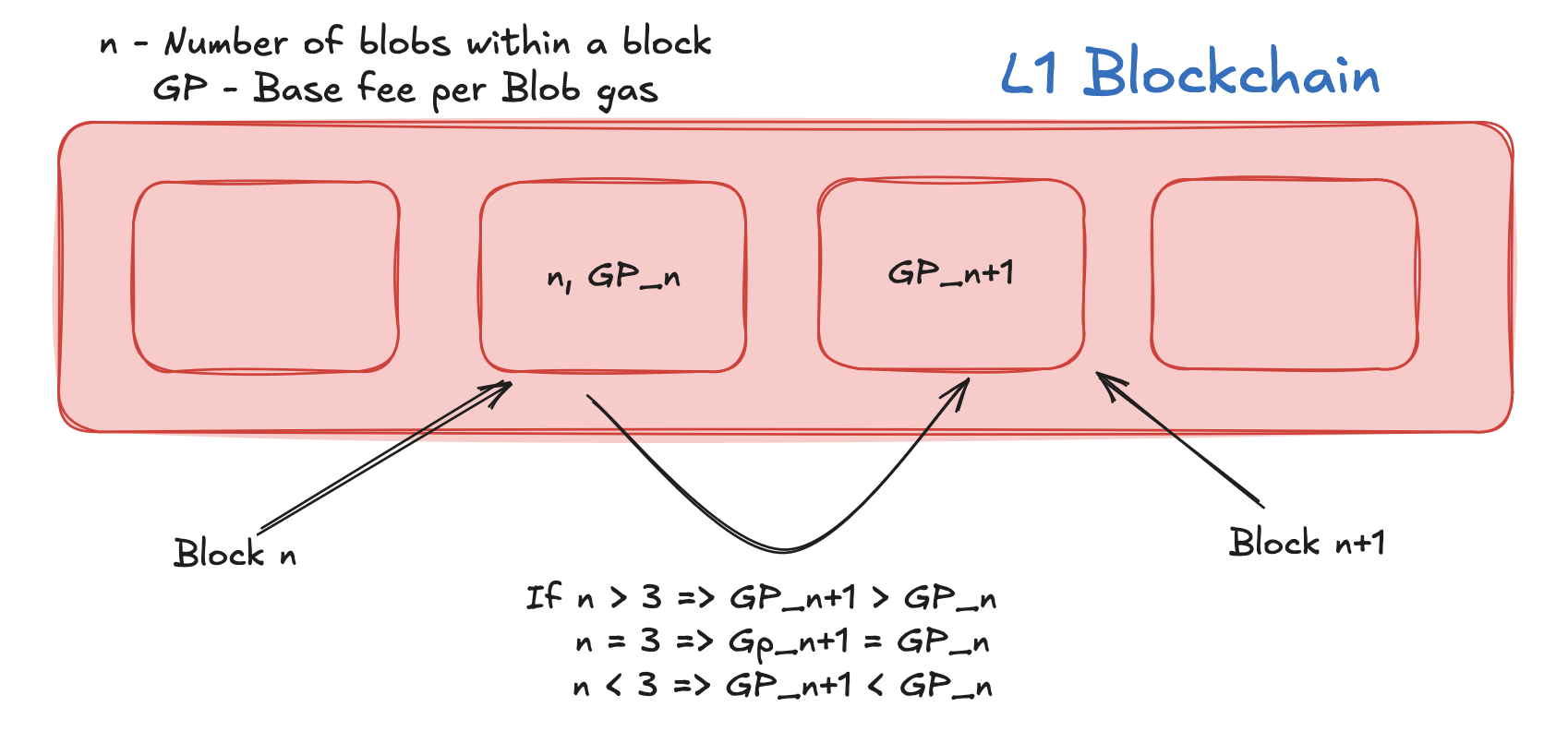
Ethereum aims for a target of 3 blobs per block, which is used to maintain balance over the network.
If a block uses more than the 3 blobs, the
excess_blob_gasvalue increases, this signals high demand, and the base fee per blob gas also increases exponentially for the next block to disincentivize overuse.Similarly, if if a block uses less than 3 blobs, then
excess_blob_gasvalue decreases, making the blob gas fee for the next block decrease

What is BLOBHASH Opcode?
BLOBHASH opcode does not give you access to the blob's data, rather gives you the versioned hash of a blob that was attached to the transaction. As previously mentioned versioned hash is a 32-byte cryptographic commitment to the blob's content.
It is impossible to use the BLOBHASH opcode to get the versioned hash of a transaction that has already been executed.
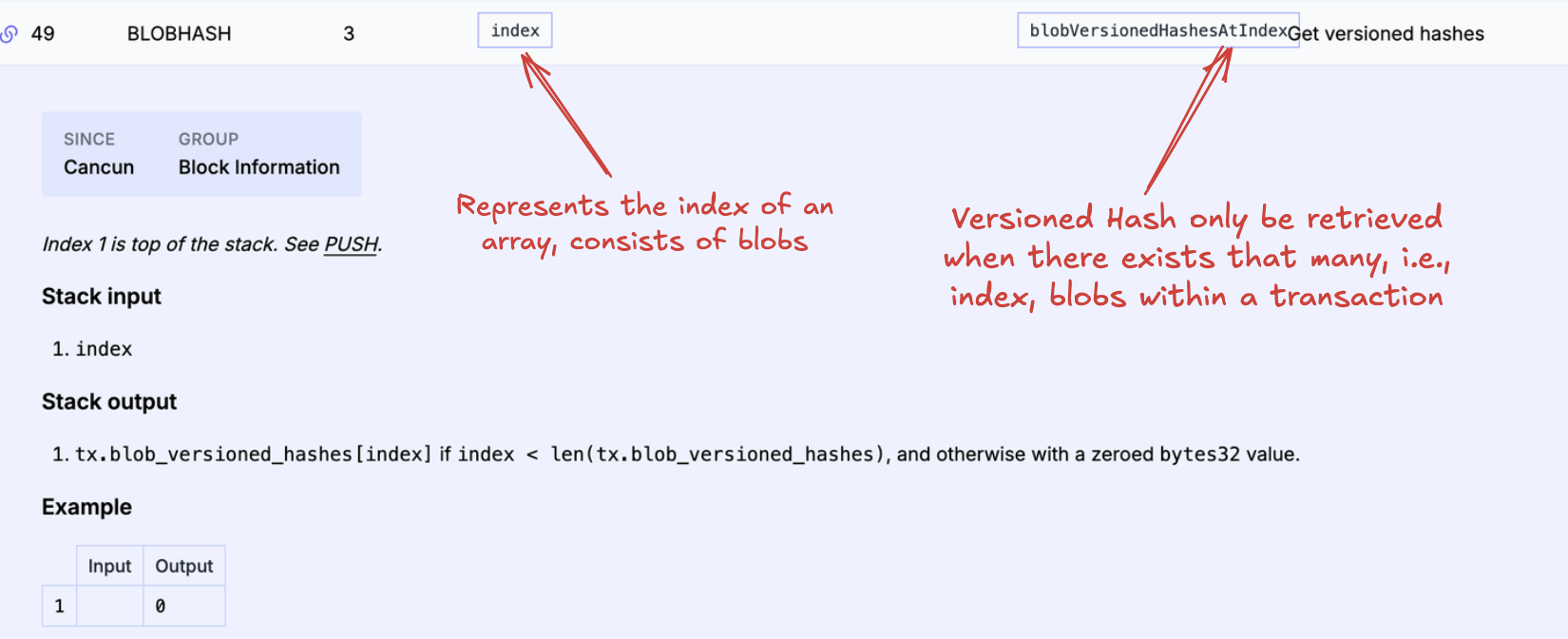
The BLOBHASH opcode is designed to give a smart contract information about the transaction that is currently being executed. Its sole job is to answer the question: "As this transaction is running right now, what are the versioned hashes of the blobs that were submitted with me?"
Drawbacks of Blobs
The implementation of EIP-4844 resulted in inclusion of addition data field, called blobs into the nodes, increasing the propagation size, which impacted synchronization times, making it longer for nodes to sync new slots. Consequently, the fork rate has risen from 3.097 to 6.707 slots per 2000 slots, indicating a direct impact on network stability.
Reason for increasing fork rate
When the synchronization time increases, nodes may not receive the new block in time to build upon it, which lead to multiple miners proposing new blocks for same slot, creating a fork.
A fork is essentially a temporary divergence in blockchain’s history. While these forks are usually resolved quickly, a higher fork rate indicates that the network is having more difficulty reaching a consensus
Summary
EIP-4844, also known as "Proto-Danksharding," is a pivotal upgrade for Ethereum that acts as the first step toward a fully sharded network. Its main goal is to drastically reduce the cost of transactions on L2 rollups. Before introduced this EIP standard, rollups were forced to store their transaction data permanently on the Ethereum mainnet using CALLDATA, a method that was both expensive and inefficient to verify the data on L1.
EIP-4844 addresses this by introducing a new data layer called blobs. Unlike CALLDATA, blobs are designed for temporary storage, remaining on the network for only about 18 days—just long enough for L2s to verify their transactions. This temporary storage, combined with the fact that blob data is not accessible to the EVM, makes them significantly cheaper and more efficient.
To make blobs work, EIP-4844 introduced several key technical changes. It created a new transaction type (Type-3) to handle blobs and established a separate pricing mechanism for them, which adjusts based on demand to maintain network stability.
References
https://www.cyfrin.io/blog/what-is-eip-4844-proto-danksharding-and-blob-transactions
https://www.quicknode.com/guides/ethereum-development/transactions/eip4844-explained
https://eips.ethereum.org/EIPS/eip-4844
https://docs.web3j.io/4.14.0/transactions/EIP_transaction_types/eip4844_blob_transaction/
https://hacken.io/discover/eip-4844-explained/
https://www.blocknative.com/blog/eip-4844-blobs-and-blob-gas-what-you-need-to-know
https://eips.wiki/eips/protocol/execution/eip-4844/
https://medium.com/@amarachiugwu/l2s-just-bulked-c31adafb5228
Author - Sai Nikethan
Intern, Security Researcher @TECHFUND