TECHFUND
Media

Solana Deep Dive: Accounts, Execution & How the Magic Happens
Welcome back, explorer! Last time we rode the Solana rollercoaster and saw why it’s fast, cheap, and different. But how does it pull off this speed? What's going on under the hood?
It all starts with something called... Accounts.
What is an Account in Solana?
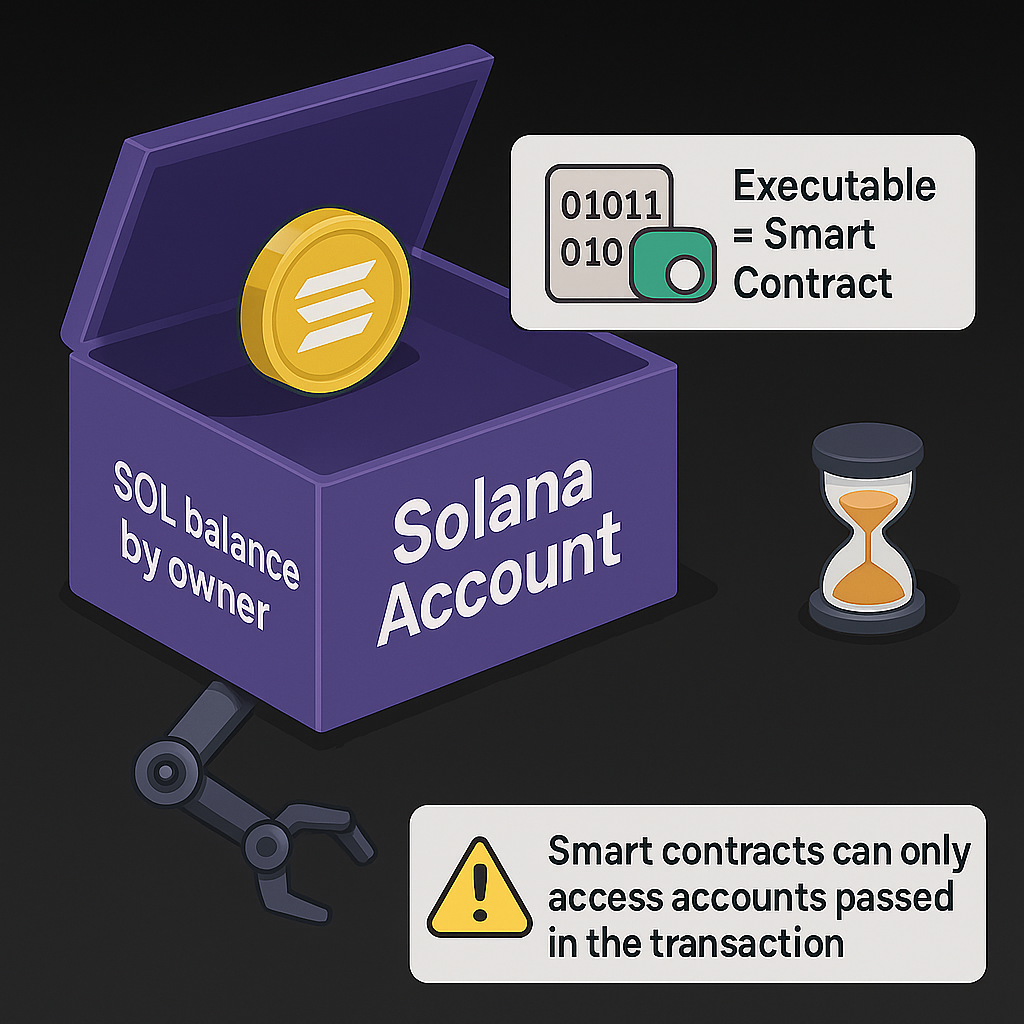
Think of accounts like storage boxes on the Solana blockchain. Everything lives inside them – from your SOL balance to smart contract code and their data.
But here’s the twist: Unlike Ethereum where only users have accounts, in Solana everything is an account.
Unlike Ethereum where smart contracts can access any variable they declared, in Solana:
Smart contracts are stateless
They can’t store data inside themselves
They operate only on the accounts passed into the transaction
There are 2 main types:
User Account (Wallet) – like your personal box where you keep your SOL and NFTs.
Program Account – holds the code of smart contracts.
Data Accounts – stores data used by programs, like a game scoreboard, a DAO treasury, or a NFT collection’s metadata.
In short: Code and data are stored separately in Solana. Programs don’t “own” data – they interact with external accounts passed into them.
Access Control via Ownership
A program can only modify accounts that it owns.
So even if an attacker passes someone else's account into your program, it can’t touch it unless that account’s owner matches your program's ID.
This is how Solana enforces access control at the system level.
Account Size and Rent
Solana requires you to predefine how much space an account will need. Why?
Because space costs money – or in Solana terms, rent.
Accounts must be rent-exempt to stay alive.
To make an account rent-exempt, you must deposit enough SOL based on its size.
If an account becomes empty (zero SOL + zero data), it gets purged automatically.
Anatomy of a Solana Account
Let’s peek inside one of these boxes 🧰. Every Solana account contains:
lamports: How much SOL it holds (like gas/fuel).owner: Which program is allowed to access it.data: The actual byte content stored inside.executable: Is this a smart contract? If yes, it’s marked executable.rent_epoch: Solana charges “rent” to keep data alive – unless the account is rent-exempt (has enough SOL).
Smart contracts don’t write wherever they want. They can only touch accounts explicitly passed to them during a transaction!
How Transactions Work in Solana
Solana does something really clever with transactions:
When you send a transaction, you must list all the accounts it will read or write.
This makes things super transparent and predictable.
And since the system knows which accounts are touched... it can run multiple transactions in parallel if they don’t overlap!
💡 That’s the secret behind Sealevel – Solana’s ultra-fast execution engine.
What is Sealevel?
Imagine a massive kitchen with 100 chefs. Most blockchains make them share one cutting board. Solana gives each chef their own space as long as they don’t chop the same vegetables (accounts)!
Sealevel allows:
Multiple contracts to run at once
Efficient CPU & GPU usage
Non-overlapping transactions to scale horizontally
This is why Solana doesn’t slow down when thousands of users pile in – it scales out, not just up.
Writing Programs with This in Mind
As a Solana dev, you’ll:
Define what accounts your program needs.
Use a framework like Anchor to make this easier.
Manage account constraints, like “is this writable?”, “is it a signer?”, or “is it rent-exempt?”
And yes – you can deserialize data in accounts, modify it, and serialize it back. Think of it like pulling a file out of a box, editing it, and putting it back in the same order.
Wrapping It All Up
Solana flips the traditional smart contract model on its head – and that’s what gives it superpowers. By separating code from data, enforcing strict access control through ownership, and unlocking parallel execution with Sealevel, Solana isn’t just fast — it’s architecturally elegant.
If Ethereum is a single-lane highway, Solana is a multi-lane autobahn. But with great speed comes great responsibility: as a developer, you need to think carefully about accounts, access, and execution flow.
Now that you understand how the engine runs, you're not just a passenger anymore — you're ready to drive. 🏎️
Author - Abhan
Intern, Security Researcher @TECHFUND