TECHFUND
Media


Minerercx Vulnerability Exploited: Understanding the $460k Hack
What Happened?
On February 14, 2024, @minerercx exploited a vulnerability in the Minerercx smart contract, resulting in a significant loss of $460,000.
What is Minerercx?
Minercx is a decentralized platform built on the ERC-X and LayerZero Labs technologies. It allows users to participate in a process called token volatility farming, where they can potentially earn rewards based on the price fluctuations of cryptocurrencies. Minerercx also boasts a collection of 10,000 unique avatars enabled by the ERC-X standard.
The Exploited Vulnerability:
The vulnerability resided within the smart contract's _update function, which is responsible for handling token transfers. This function unfortunately relied on cached balance values for both the sender and recipient of the tokens. This mechanism created a loophole when a user transferred tokens to themselves within the same transaction.
Breaking Down the Vulnerability:
Self-Transfer Trigger: The _update function was triggered with the from and to addresses being identical, signifying a self-transfer.
Cached Values Used: Before the actual transfer took place, the function retrieved the cached balance values for both the sender and recipient (which was the same address in this case).
Double Update: The function then subtracted the transfer amount from the cached sender balance and added the same amount to the cached recipient balance.
Unintended Consequence: Since both cached values pointed to the same address, this operation essentially doubled the user's balance, leading to the exploitation.
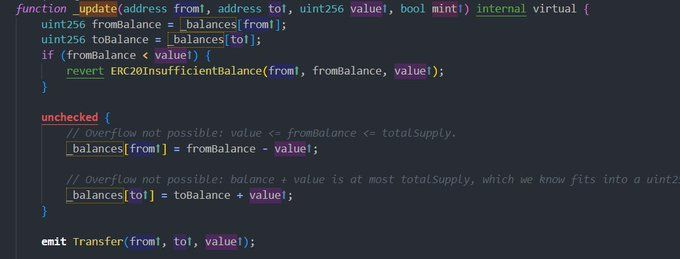
Hack transaction : https://etherscan.io/tx/0x5cc93e9d5adec2b432ddf8052ed77a052e07671db36954675d6f55df28bdb8c0
Impact of the Exploit:
This vulnerability allowed the attacker to manipulate the smart contract and gain unauthorized access to a significant amount of funds, resulting in a loss of $456,000.
Mitigation of this vulnerability
1. Modify the update Function: Adjust the update function within the smart contract to retrieve real-time balance values for both the sender and recipient of the tokens during token transfers. This modification ensures that cached balance values are not relied upon.
2. Add a validation check within the function to ensure that the "address from" which tokens are sent and the "address to" which tokens are sent are never the same within a single transaction.
This incident highlights the importance of thorough smart contract audits and robust security measures in the decentralized finance (DeFi) space.
Written by Piyush shukla